

Classification of mixtures & pure substances
Classification of mixtures & pure substances
|
Matter is divided into two broad classes. Mixtures and pure substances. Mixtures are a physical or mechanical combination of materials. The mixture can be made in any proportions. The composition is 'flexible'. A combination can be uniform and homogeneous like homogenized milk. Or it can be heterogeneous like chocolate chip cookies. The chocolate chips not uniformly mixed throughout the cookie. Another heterogeneous mixture is salad dressing. shaking mixes the oil and water into assorted sized globs. The mixture separates when allowed to stand. Gravity physically pulls the denser water layer down under the lighter less dense oil.
|
|
physical change |
||
|
mixture |
<--------------> |
pure substances |
|
Mixtures can be made in any proportions. Salt water can be a liter of water with a few grams of salt. Salt water can also be a saturated solution of a liter of water and more than 400 grams of salt. The particles retain their identities and the original substances can be recovered using physical process. Sand and iron filings can be mixed. The iron can be removed using a strong magnet. |
|
Pure substances: Water
is always H2O. the formula and composition is always the same. The composition of common table salt always is NaCl. The count of sodium ions and chloride ions is always one to one. When you make salt water the mixture is mechanical. The particles in the mixture will still be H2O and the ions from NaCl. |
|
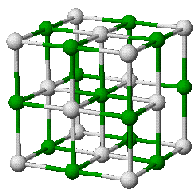
Sodium chloride, NaCl, crystal the white spheres represent sodium ions, Na1+, and the green spheres represent chloride ions, Cl1-. |
|
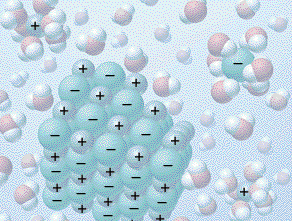
The illustration below shows what happens to a salt crystal as it dissolves in water. If the water is boiled away the salt will form crystalline NaCl. |
|
Exercise: Would you classify air as a pure substance or a mixture? Click for answer |
|
|


